02-21-2010, 08:05 AM
|
#1
|
|
Registered User
Join Date: Nov 2008
Location: Massachusetts
Posts: 4,810
|
Jaay,
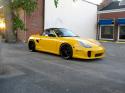
I'm convinced that you're involved in a clandestine project with NASA to turn your boxster into the next space shuttle. Over and out !
|
|
|
02-21-2010, 08:34 AM
|
#2
|
|
Porscheectomy
Join Date: Mar 2006
Location: Seattle Area
Posts: 3,011
|
Just curious. Why just the sensor+gauge and extra bung instead of a WEGO with data logging and a narrow band simulator that would replace one of the existing sensors? Logging with rpm and load sensing sure makes tuning much easier, especially with one person. You wouldn't need the extra bung either.
|
|
|
02-21-2010, 04:45 PM
|
#3
|
|
07 Carrera S Cab
Join Date: Nov 2005
Location: New Jersey
Posts: 2,273
|
Jay, the only thing I understand in your post is the ale. Lol. What is that you are installing?!
__________________
Current: 07 Carrera S Cab in Midnight Blue
Previous: 01 Boxster in Arctic Silver, 86 944 in Guards Red
|
|
|
02-21-2010, 05:15 PM
|
#4
|
|
Porscheectomy
Join Date: Mar 2006
Location: Seattle Area
Posts: 3,011
|
Quote:
|
Originally Posted by Boxtaboy
Jay, the only thing I understand in your post is the ale. Lol. What is that you are installing?!
|
Typical narrow band oxygen sensors found in most cars are only accurate in reading the oxygen content in an exhaust stream (and therefore projecting the air/fuel ratio) near the stoichiometric ratio. This is only useful when the car is running at low loads (cruising) when you want the engine to be running near this ratio. They aren't accurate at reading the air/fuel ratio when the car is at high load (accelerating) or idle. Therefore, they're not very useful for tuning an engine.
The wide band oxygen sensor has a different construction that allows it to be accurate for a much wider range of air/fuel ratios. With this sensor, you can measure and tune an engine for optimal operation under all driving conditions.
|
|
|
02-21-2010, 07:14 PM
|
#5
|
|
Registered User
Join Date: Dec 2006
Location: shoreham, ny
Posts: 1,619
|
What he said
__________________
996 3.4 engine with 2.7 986 5speed transmission
Ebay Headers, Fabspeed high flow cats, JIC Cross, IPD Plenum, H&R Coilovers, B&M Short Shifter, AEM Uego Gauge Type Analog, Apexi S-AFC Select, 987 air box, Litronics, 2000 Tails and side markers, painted center console, 18" 987 S-Wheels, GT3 Front bumper with splitter.
|
|
|
03-23-2010, 04:45 AM
|
#6
|
|
Registered User
Join Date: Feb 2010
Location: Central PA
Posts: 49
|
Quote:
|
Originally Posted by blue2000s
Typical narrow band oxygen sensors found in most cars are only accurate in reading the oxygen content in an exhaust stream (and therefore projecting the air/fuel ratio) near the stoichiometric ratio. This is only useful when the car is running at low loads (cruising) when you want the engine to be running near this ratio. They aren't accurate at reading the air/fuel ratio when the car is at high load (accelerating) or idle. Therefore, they're not very useful for tuning an engine.
The wide band oxygen sensor has a different construction that allows it to be accurate for a much wider range of air/fuel ratios. With this sensor, you can measure and tune an engine for optimal operation under all driving conditions.
|
Jaay, congradulations on the baby. Kids are great. I have 4 myself.
Anyway, I too am new to Boxsters and a lot of this tecnical jargon. Though I have done a lot of my own basic car maintenence and repairs, I have never done any performance mods to any of my cars.
Let me see if I can get this streight:
- This gets installed on the exhaust
- I presume it somehow gets hooked into the cars computer?
- It can help the cars computer to improve air/fuel ratios
- It can improve performance and I would also presume efficiency
Anything else missing?
Frans
|
|
|
03-23-2010, 05:56 AM
|
#7
|
|
Registered User
Join Date: Nov 2007
Location: Ottawa
Posts: 92
|
What MAF housing are you running? 3.5" or stock?
I should probably see if I'm running rich on my 3.4 swap as well.
Also let us know how the H&R Coils handle.
Thanks!
Mike
|
|
|
03-23-2010, 06:42 AM
|
#8
|
|
Porscheectomy
Join Date: Mar 2006
Location: Seattle Area
Posts: 3,011
|
Quote:
|
Originally Posted by backman_z
Jaay, congradulations on the baby. Kids are great. I have 4 myself.
Anyway, I too am new to Boxsters and a lot of this tecnical jargon. Though I have done a lot of my own basic car maintenence and repairs, I have never done any performance mods to any of my cars.
Let me see if I can get this streight:
- This gets installed on the exhaust
- I presume it somehow gets hooked into the cars computer?
- It can help the cars computer to improve air/fuel ratios
- It can improve performance and I would also presume efficiency
Anything else missing?
Frans
|
Aftermarket wide band O2 sensors include the sensor and a power/converter box that will power the sensor and convert the reading from the sensor to one that you can read. It also includes output signals so that the data can be read and collected by another device, like an ECU or laptop. This box almost always has a readout on it so that you don't really need to get another gauge. The output from a wideband sensor is NOT compatible with that of a narrow band sensor, so you can't just plug a wideband into your car and go. Widebands have outputs from 0-5V in a very linear fashion, narrow bands read from 0-1V and have a very non-linear characteristic.
You can get wide bands on your car in a couple of ways. You can add another bung to the header, as JAAY did and it will be completely independent of the existing feedback system.
They also have versions that will simulate a narrow band signal so that you can remove the O2 sensor that's already there, screw in the wide band, and plug the narrow band connector into the converter box.
Along with the wideband and converter box, you need some way to tune your AFR, either by controlling the DME or by interrupting the MAF signal that goes into the DME with another controller box. This box adjusts the MAF signal going into the DME to richen or lean the mixture for any given running condition.
The wideband is essential for proper engine tuning. It's the best way to know what your AFR is during non-cruising conditions. Having said that, if you're not tuning the car yourself, there's really no point to installing one.
|
|
|
03-23-2010, 08:28 AM
|
#9
|
|
Registered User
Join Date: Dec 2006
Location: shoreham, ny
Posts: 1,619
|
On my phone now so this will be short. The wide band is in. The autometer single pod is perfect. Ill get some photos up for you. I am running 3.5 maf housing. Tuning with a apexi afc select. I was running down in the 10.2 range now with a quick tune am at 12.5. The car f$&@ing rips now. I'll get photos and video up as soon as I can. I'll post up soon.
__________________
996 3.4 engine with 2.7 986 5speed transmission
Ebay Headers, Fabspeed high flow cats, JIC Cross, IPD Plenum, H&R Coilovers, B&M Short Shifter, AEM Uego Gauge Type Analog, Apexi S-AFC Select, 987 air box, Litronics, 2000 Tails and side markers, painted center console, 18" 987 S-Wheels, GT3 Front bumper with splitter.
|
|
|
03-23-2010, 10:12 AM
|
#10
|
|
Registered User
Join Date: Feb 2010
Location: Central PA
Posts: 49
|
Quote:
|
Originally Posted by blue2000s
Aftermarket wide band O2 sensors include the sensor and a power/converter box that will power the sensor and convert the reading from the sensor to one that you can read. It also includes output signals so that the data can be read and collected by another device, like an ECU or laptop. This box almost always has a readout on it so that you don't really need to get another gauge. The output from a wideband sensor is NOT compatible with that of a narrow band sensor, so you can't just plug a wideband into your car and go. Widebands have outputs from 0-5V in a very linear fashion, narrow bands read from 0-1V and have a very non-linear characteristic.
You can get wide bands on your car in a couple of ways. You can add another bung to the header, as JAAY did and it will be completely independent of the existing feedback system.
They also have versions that will simulate a narrow band signal so that you can remove the O2 sensor that's already there, screw in the wide band, and plug the narrow band connector into the converter box.
Along with the wideband and converter box, you need some way to tune your AFR, either by controlling the DME or by interrupting the MAF signal that goes into the DME with another controller box. This box adjusts the MAF signal going into the DME to richen or lean the mixture for any given running condition.
The wideband is essential for proper engine tuning. It's the best way to know what your AFR is during non-cruising conditions. Having said that, if you're not tuning the car yourself, there's really no point to installing one.
|
After instalation of the wide band sensor and converter, do I have to take the car to a tuning shop and get the ECU re-tuned to match the new controller?
Or can the new controller box tune by sending a new signal (overriding the stock signal) to the cars computer.
Am I getting closer to understanding, or am I way out in left field?
Frans
Also: It sounds as though Jaay is getting more power. Does it also become more efficient?
|
|
|
Posting Rules
|
You may not post new threads
You may not post replies
You may not post attachments
You may not edit your posts
HTML code is On
|
|
|
All times are GMT -8. The time now is 12:51 PM.
| |