 06-22-2020, 05:00 AM
|
#21
|
|
Registered User
Join Date: Aug 2013
Location: NORTHAMPTON
Posts: 63
|
Code Reader screen shot photos at idle
Not sure what sections relate to checking varioCam working correctly? These readings are on idle.


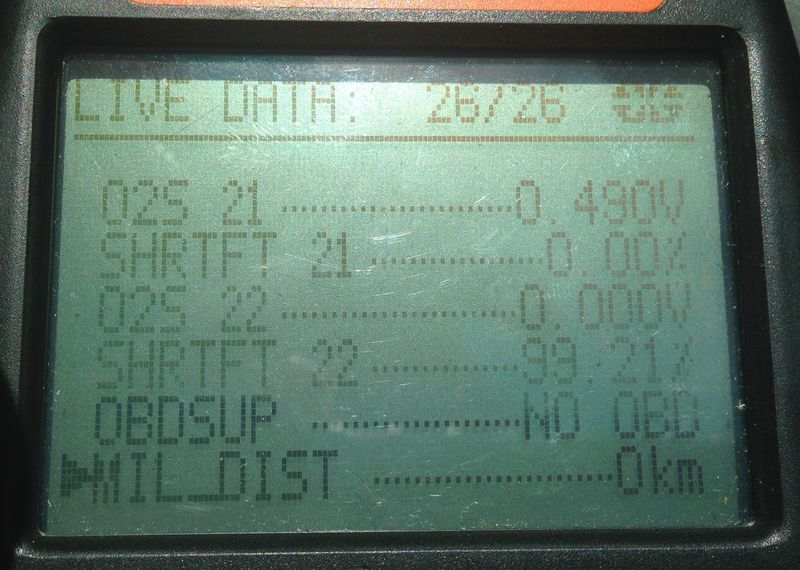
The reading of the section I guessed were relevant at 3000 revs are;
LTFT - B1 27.34%
LTFT - B2 28.12%
STFT - B1 0-2.34%
STFT - B2 0-3.12%
Spark advance 19.5%
SHRTFT 11 -10%
SHRTFT 12 99.21%
I have (honestly) no idea what these "LTFT" etc actually mean and if anybody can look at these readings and suggest areas of concern or help then please do. I just need to know what section to look at when it is driven over 3000 revs (by co-pilot)?
|

|

|
|
06-22-2020, 05:23 AM
|
#22
|
|
Will there be cake?
Join Date: Mar 2017
Location: East Coast
Posts: 623
|
LTFT and STFT are fuel trim stats, (Long term and short term fuel trim) as I understand it. What I see that seems odd is the coolant temp. is that 92 celcius= nearly 200 degrees Fahrenheit?
|
|
|
|
|
06-22-2020, 05:37 AM
|
#23
|
|
Registered User
Join Date: Feb 2005
Location: It's a kind of magic.....
Posts: 6,666
|
Quote:
Originally Posted by tonythetiger

LTFT and STFT are fuel trim stats, (Long term and short term fuel trim) as I understand it. What I see that seems odd is the coolant temp. is that 92 celcius= nearly 200 degrees Fahrenheit?
|
Not at all odd, most of these cars with the factory thermostat are running 210-215F.
__________________
“Anything really new is invented only in one’s youth. Later, one becomes more experienced, more famous – and more stupid.” - Albert Einstein
|

|
|
|
06-22-2020, 06:35 AM
|
#24
|
|
Registered User
Join Date: Aug 2018
Location: Woodland Wa
Posts: 1,320
|
Quote:
Originally Posted by tonythetiger
LTFT and STFT are fuel trim stats, (Long term and short term fuel trim) as I understand it. What I see that seems odd is the coolant temp. is that 92 celcius= nearly 200 degrees Fahrenheit?
|
Normal operating temp for the conditions.
Car is sitting still and the fans have not kicked on yet.
Normal temp for just about any car I can think of for the conditions.
|
|
|
|
|
06-22-2020, 06:58 AM
|
#25
|
|
Registered User
Join Date: Aug 2018
Location: Woodland Wa
Posts: 1,320
|
Quote:
Originally Posted by DaveBBOXSTER
Not sure what sections relate to checking varioCam working correctly? These readings are on idle.
The reading of the section I guessed were relevant at 3000 revs are;
LTFT - B1 27.34%
LTFT - B2 28.12%
STFT - B1 0-2.34%
STFT - B2 0-3.12%
Spark advance 19.5%
SHRTFT 11 -10%
SHRTFT 12 99.21%
I have (honestly) no idea what these "LTFT" etc actually mean and if anybody can look at these readings and suggest areas of concern or help then please do. I just need to know what section to look at when it is driven over 3000 revs (by co-pilot)? |
You need a scanner that will show degrees of camshaft advance.
Then you watch the camshaft advance when you get above the actuator trigger threshold. (1500 RPM I think) the camshaft advance will jump up.
An easier way is a scanner that can actuate the Variocam actuators.
You trigger an actuator at idle with the scan tool and you hear and feel the motor run differently= rougher. You can trigger one side at a time.
Both of my scanners can do it, makes testing the function of actuators, injectors and other modules simple.
If you decide to go for another scanner look at Foxwell. Mine is the 520NT Pro, under $200.00 US.
I think they have upgraded to a 530NT now as mine is a year or two old.
Last edited by blue62; 06-22-2020 at 07:05 AM.
|
|
|
|
|
06-22-2020, 08:05 AM
|
#26
|
|
Registered User
Join Date: Oct 2018
Location: North Cali
Posts: 858
|
Quote:
Originally Posted by blue62
Normal operating temp for the conditions.
Car is sitting still and the fans have not kicked on yet.
Normal temp for just about any car I can think of for the conditions.
|
Agreed. In most European cars fan switch turns on at 92 C and off at 82 C, so at idle or in heavy traffic coolant temperature varies between these two values.
Foxwell looks like a good deal. What`s the advantage of Durametric over this? I`ll need to buy one soon too.
|
|
|
|
|
06-22-2020, 11:15 AM
|
#27
|
|
Registered User
Join Date: Aug 2013
Location: NORTHAMPTON
Posts: 63
|
Thanks everyone for the help it looks as if my very cheap (£14) code reader isn't going to be any use on this. The temp is about right for my car (runs hot in traffic or if not on open road) but I have not noticed the side engine cooling fan starting up for ages.
Strange thing is the car is running exactly as it always has and I got it home after only 4 miles (to test it and warm it up) thinking it is going right.
A contact of mine (ex Porsche engine builder) in UK suggested that there are other green rubber items it may be; such as spark plug tube seals or 2 sump round cavity things and these can get broken up?
One of mine did have a leak and 2 tubes came out on the coils doing a spark plug change recently. 
|
|
|
|
|
06-22-2020, 11:18 AM
|
#28
|
|
Registered User
Join Date: Aug 2013
Location: NORTHAMPTON
Posts: 63
|
Quote:
Originally Posted by blue62
You need a scanner that will show degrees of camshaft advance.
Then you watch the camshaft advance when you get above the actuator trigger threshold. (1500 RPM I think) the camshaft advance will jump up.
An easier way is a scanner that can actuate the Variocam actuators.
You trigger an actuator at idle with the scan tool and you hear and feel the motor run differently= rougher. You can trigger one side at a time.
Both of my scanners can do it, makes testing the function of actuators, injectors and other modules simple.
If you decide to go for another scanner look at Foxwell. Mine is the 520NT Pro, under $200.00 US.
I think they have upgraded to a 530NT now as mine is a year or two old.
|
Yes that is exactly the kind of test it needs to be sure
|
|
|
|
|
06-22-2020, 11:38 AM
|
#29
|
|
Registered User
Join Date: Aug 2018
Location: Woodland Wa
Posts: 1,320
|
Quote:
Originally Posted by Homeoboxter
Agreed. In most European cars fan switch turns on at 92 C and off at 82 C, so at idle or in heavy traffic coolant temperature varies between these two values.
Foxwell looks like a good deal. What`s the advantage of Durametric over this? I`ll need to buy one soon too.
|
I own both.
Personally I don't see that Durametric has an advantage over the Foxwell.
The Foxwell will do everything that the Durametric enthusiast model will do.
My Foxwell was around $175.00 shipped.
I think Durametric is around $350.00 for the enthusiast model and around $750.00 for the professional model.
Durametric: you need a laptop
It is Porsche specific=it only reads Porsche
The enthusiast model is limited to use on Three vin numbers
some info is a little difficult to follow such as the way RPM ranges are laid out for fuel trims
Foxwell:
Standard scanner= no laptop needed
it comes loaded with what ever manufacture specific program you choose
You can add additional manufactures for around $60.00 per manufacture.
Your not limited to how many different Vins you connect to.
You can do the normal scans, live data, freeze frame, graphs etc. on any OBDII compliant system.
You only need manufacture specific programs to access manufacture specific codes or functions.
Screen layouts are of course different between the two.
Durametric is typical computer layout with various folders
Foxwell is typical OBDII scanner layout.
I think Foxwell is a very good buy for the money
Last edited by blue62; 06-22-2020 at 01:19 PM.
|
|
|
|
|
06-22-2020, 02:21 PM
|
#30
|
|
Registered User
Join Date: Jan 2018
Location: Houston
Posts: 221
|
Yes I have the green particles in my filter .I checked my active cam timing and it was determined that my vario cam is working .Tested at 4500 rpm and 26 degree of advance showed deviation of 2.xxx .My motor is a RND engine with 23 thousand miles they said its the color of the sealant they use . I continue to monitor my timing and oil.And drive it everyday .There is a pic on this post that shows a vario cam actuator that the piston came all the way out .I would like to ask the owner if the tan plastic guide was completely gone ? I have no rattling sound .Do the o-ring get old and brittle and break or dose the piston come out so far that they fall off ? I don't know what my issue is or if I have one or not.
Last edited by gabedrummin; 06-22-2020 at 02:34 PM.
|
|
|
|
|
06-22-2020, 02:23 PM
|
#31
|
|
Registered User
Join Date: Oct 2018
Location: North Cali
Posts: 858
|
Quote:
Originally Posted by blue62
I own both.
Personally I don't see that Durametric has an advantage over the Foxwell.
The Foxwell will do everything that the Durametric enthusiast model will do.
My Foxwell was around $175.00 shipped.
I think Durametric is around $350.00 for the enthusiast model and around $750.00 for the professional model.
Durametric: you need a laptop
It is Porsche specific=it only reads Porsche
The enthusiast model is limited to use on Three vin numbers
some info is a little difficult to follow such as the way RPM ranges are laid out for fuel trims
Foxwell:
Standard scanner= no laptop needed
it comes loaded with what ever manufacture specific program you choose
You can add additional manufactures for around $60.00 per manufacture.
Your not limited to how many different Vins you connect to.
You can do the normal scans, live data, freeze frame, graphs etc. on any OBDII compliant system.
You only need manufacture specific programs to access manufacture specific codes or functions.
Screen layouts are of course different between the two.
Durametric is typical computer layout with various folders
Foxwell is typical OBDII scanner layout.
I think Foxwell is a very good buy for the money
|
Thanks for the useful info  . I think I`m gonna get one.
|
|
|
|
|
06-23-2020, 12:46 AM
|
#32
|
|
Registered User
Join Date: Aug 2013
Location: NORTHAMPTON
Posts: 63
|
That is interesting because it does mean you can have green bits in the filter and still everything still works - although it seems your green bits are sealant used in the engine rebuild.
What I find annoying is that with these cases (where an engine may be very close to the point of imploding) there is no engine warning light or codes coming up to indicate this. I guess it is just the same as in a car that has a timing belt failure.
I looked at the tensioner cylinder design and it basically just actuates slightly (in and out) in a barrel with seals designed to stop engine oil getting in (presumably) and is activated by the electrical solenoid to make a mechanical movement to tension or release tension. IMO even with the seals broken it probably would still operate (and like the dreaded IMS bearing, when the seals fail be lubricated by oil not grease)? If the solenoid goes then it wont work and you'd get a code fault? But if the seals break down the engine has no idea and the tensioner barrel, being metal can just continue to function and the system doesn't detect any malfunction (because it opens and closes but is more lubricated or the tolerance is such that the external engine oil has no effect. Is the varioCam tensioner a sealed unit or does it take oil from the engine? Guess the seals are there to maintain the internal pressure of the tensioner and without them the power of the pressure is reduced or limited? So many questions...
The fact that Porsche changed the system on the 2002 facelift version to use the VW Audi one is indicative they decide the new one was better or cheaper.
Also, I wonder whether the varioCam units are the same design on the earlier 911 engines and have they ever failed?
Hartech, (engine builders in UK) said when I spoke to them that the real issue was getting an engine failure by the particles blocking the oil pump feed and that an engine flush or sump removal may be a good idea.
|
|
|
|
|
06-23-2020, 01:08 AM
|
#33
|
|
Registered User
Join Date: Jul 2017
Location: SoCal
Posts: 118
|
I’ve been following this thread and good I also have Foxwell NT520 but never really use all the features except when I have to fix my ABS. But was able to help friends with their check engine and obdii functions for smog purposes.
Like the previous members said, why is it with smog related issue, cars will trigger a check engine even with just small issue, but any deviation from variocam or tensioner that can cause engine failure/catastrophe will not give any check engine. Smog requirements is more priority but engine failure is not, from car manufacturing design?
Last edited by ndfrigi; 06-23-2020 at 08:34 AM.
|
|
|
|
|
06-23-2020, 08:18 AM
|
#34
|
|
Registered User
Join Date: Oct 2018
Location: North Cali
Posts: 858
|
Quote:
Originally Posted by DaveBBOXSTER
That is interesting because it does mean you can have green bits in the filter and still everything still works - although it seems your green bits are sealant used in the engine rebuild.
What I find annoying is that with these cases (where an engine may be very close to the point of imploding) there is no engine warning light or codes coming up to indicate this. I guess it is just the same as in a car that has a timing belt failure.
I looked at the tensioner cylinder design and it basically just actuates slightly (in and out) in a barrel with seals designed to stop engine oil getting in (presumably) and is activated by the electrical solenoid to make a mechanical movement to tension or release tension. IMO even with the seals broken it probably would still operate (and like the dreaded IMS bearing, when the seals fail be lubricated by oil not grease)? If the solenoid goes then it wont work and you'd get a code fault? But if the seals break down the engine has no idea and the tensioner barrel, being metal can just continue to function and the system doesn't detect any malfunction (because it opens and closes but is more lubricated or the tolerance is such that the external engine oil has no effect. Is the varioCam tensioner a sealed unit or does it take oil from the engine? Guess the seals are there to maintain the internal pressure of the tensioner and without them the power of the pressure is reduced or limited? So many questions...
The fact that Porsche changed the system on the 2002 facelift version to use the VW Audi one is indicative they decide the new one was better or cheaper.
Also, I wonder whether the varioCam units are the same design on the earlier 911 engines and have they ever failed?
Hartech, (engine builders in UK) said when I spoke to them that the real issue was getting an engine failure by the particles blocking the oil pump feed and that an engine flush or sump removal may be a good idea.
|
You may wanna reread my comment #11. The actuator is operated by oil pressure, not by the solenoid, the solenoid operates a valve only that channels oil flow to the piston that advances the timing of the intake camshaft. If the solenoid is faulty, probably the ECU will see that and may trigger the check engine light. I`m just guessing here. If the actuator is not working because it can`t hold the pressure, then you won`t have cam advancement, but your engine is not in danger, not like when timing gets messed up. Just it won`t perform as it should at a certain rpm range. The seals are there to hold the pressure, not for stopping engine oil getting into the actuator. I agree, pulling the sump is probably a good idea to clean the rest of the debris off the oil pickup strainer.
|
|
|
|
|
06-23-2020, 04:54 PM
|
#35
|
|
Will there be cake?
Join Date: Mar 2017
Location: East Coast
Posts: 623
|
Quote:
Originally Posted by JFP in PA
Not at all odd, most of these cars with the factory thermostat are running 210-215F.
|
interesting. I have only referenced the drivers gauge for temp, never seen mine step up above about 185 on a hot summer day, fans blazing. I will play with my duremetric and see if this is different. I just replaced the thermo with a 72C, but the driver gauge only shows about a 3-4 degree lower (183 was "normal" now it hits 180 and sticks)
thanks!
|
|
|
|
|
06-23-2020, 05:17 PM
|
#36
|
|
Registered User
Join Date: Aug 2018
Location: Woodland Wa
Posts: 1,320
|
Quote:
Originally Posted by tonythetiger
interesting. I have only referenced the drivers gauge for temp, never seen mine step up above about 185 on a hot summer day, fans blazing. I will play with my duremetric and see if this is different. I just replaced the thermo with a 72C, but the driver gauge only shows about a 3-4 degree lower (183 was "normal" now it hits 180 and sticks)
thanks!
|
I just replaced my OEM thermostat with a low temp thermostat.
I then took the car on a 297 mile run with my scanner plugged into the OBDII port.
This allowed me monitor the temps that the ECU was seeing and compare readings to the dash display.
Ambient temps were from 61 degrees in the morning to 93 degrees in the afternoon.
Coolant temps ran from 183 -205 degrees depending on engine load, ambient temp, road speed, and RPM.
Coolant temps reported by the scanner corelated very closely to the dash gauge.
I have done this same test with the OEM thermostat. on the same 297 mile run.
Coolant temps in that test ran 5 degrees higher through the range.
Also I don't think the fans kick on until around 196-200 degrees. At least mine don't. Mine is a 2000S
Just as an edit to this: I looked up the trigger temps for the fans.
Low speed kicks on at 206.2F high speed kicks on at 215.6F
Last edited by blue62; 06-23-2020 at 06:42 PM.
|
|
|
|
|
06-24-2020, 12:11 AM
|
#37
|
|
Registered User
Join Date: Aug 2013
Location: NORTHAMPTON
Posts: 63
|
Quote:
Originally Posted by Homeoboxter
You may wanna reread my comment #11. The actuator is operated by oil pressure, not by the solenoid, the solenoid operates a valve only that channels oil flow to the piston that advances the timing of the intake camshaft. If the solenoid is faulty, probably the ECU will see that and may trigger the check engine light. I`m just guessing here. If the actuator is not working because it can`t hold the pressure, then you won`t have cam advancement, but your engine is not in danger, not like when timing gets messed up. Just it won`t perform as it should at a certain rpm range. The seals are there to hold the pressure, not for stopping engine oil getting into the actuator. I agree, pulling the sump is probably a good idea to clean the rest of the debris off the oil pickup strainer.
|
Yes, Thanks - I did read the point about the actuators working on oil pressure not sure if the unit is sealed or taking engine oil to operated I guess it is? I took the car out yesterday for a 20 mile test run and it ran impressively; quick revs response and power and just seemed about right (according to my previous experience of how it drives) I was cautious at first as I don't want to ruin my engine but overall it was good. I saw an ad for the full kit of new timing chains, cylinders and tensioners online for $3,500 that is a very expensive set of parts to replace!
|
|
|
|
|
06-24-2020, 01:42 AM
|
#38
|
|
Registered User
Join Date: Aug 2013
Location: NORTHAMPTON
Posts: 63
|
|
|
|
|
|
06-24-2020, 09:30 AM
|
#39
|
|
Registered User
Join Date: Oct 2018
Location: North Cali
Posts: 858
|
Quote:
Originally Posted by DaveBBOXSTER
|
Pretty cool, haven`t seen this yet, thanks!
|
|
|
|
|
06-24-2020, 12:26 PM
|
#40
|
|
Registered User
Join Date: Oct 2018
Location: North Cali
Posts: 858
|
Quote:
Originally Posted by DaveBBOXSTER
|
Just looked at the link and it got me thinking. EDIT: Knowing that the two cam actuators are different, is it possible that only one has a tendency to fail? Or this failure is rather model dependent?
I looked through a couple of threads on this matter and they were all about 2.7 engines.
I split one actuator from bank 4-6 (2.5 base), and it`s clearly different from the one pictured on the previous page in this thread (2.7). If you go back in the thread you can see both side by side. Mine had no problem with the large green O-ring, does not even have it. So is it because it`s model specific (2.5 vs 2.7) or because the one that usually fails correspond to bank 1-3? Can anyone confirm either this or the other possibility?
Last edited by Homeoboxter; 06-25-2020 at 07:05 AM.
|
|
|
|
 Posting Rules
|
You may not post new threads
You may not post replies
You may not post attachments
You may not edit your posts
HTML code is On
|
|
|
All times are GMT -8. The time now is 02:20 AM.
| |



 his/hers
 Boxster
 Linear Mode


