 05-22-2015, 05:28 PM
|
#81
|
|
Ben-Auto-Design
Join Date: Oct 2014
Location: French Riviera
Posts: 827
|
Well, yes it will be a direct fit, but you will need a new intake tube, I'm working on that part too 
My cel went one again ... so, I have a vacuum leak somewhere... and I think I know where ... that AOS vent line must be cracked again !
So, that makes me question the fact that we should keep it, or replace it with a standard piece of hose... Because everyone will break it during installation, so why bother ?
heliguy, where are you from ?
|

|

|
|
05-22-2015, 08:11 PM
|
#82
|
|
Registered User
Join Date: Nov 2008
Location: Florida
Posts: 1,111
|
I'm in Destin. How about you?
|
|
|
|
|
05-22-2015, 09:03 PM
|
#83
|
|
Need For Speed
Join Date: Feb 2013
Location: Funville
Posts: 2,114
|
Quote:
Originally Posted by heliguy

WOW! We need more air. Will yours be a direct fit, basically plug and play with the 996TB? Add a 987 airbox and we are in business?
|
Not quite. You will need to use the MAF housing from your 986 air box. So, you need to figure out a way to plum your 986 MAF housing into the 987 air box.
__________________
2003 Boxster S
| 987 Air Box | K&N Air Filter | 76mm Intake Pipe| 996 76mm TB | 997 Distribution T | Secondary Cat Delete Pipes | Borla Muffler | NHP 200 Cell Exhaust Headers |
|
|
|
|
|
05-23-2015, 07:15 AM
|
#84
|
|
Registered User
Join Date: Sep 2009
Location: toronto
Posts: 2,668
|
Nice ....so stock plenum boots can be used as the tee diameters match the plenums? This is a major potential loss area when using the 997 diverter tee.
If it puts the tb in the same you might be able to work with the stock 3.2 intake tube ....modified get the end
Quote:
Originally Posted by Ben006
As I say on the top of this page, around 300$, but I will depend on wethet I need to paint it or not
I will try to get it on the dyno, but I can't garantee it :/
The testing will be more about reliability. I will put it on my car, and abuse it, then take it off and see if there is any problem.
Then, if I decide that it's good, you will get some
I hope the sensor was the problem, will see next week if the CEL comes back.
Yes, the TB will sit at the stock location
Ben |
__________________
986 00S
|
|
|
|
|
05-23-2015, 09:08 AM
|
#85
|
|
Ben-Auto-Design
Join Date: Oct 2014
Location: French Riviera
Posts: 827
|
As I said, the stock intake tube can't be reused, its tapered all the way, starting from the MAF housing. so you will not get the full benefit of the new TB.
Heliguy, I'm in Delray Beach, not very close ^^
|
|
|
|
|
05-24-2015, 12:59 PM
|
#86
|
|
Registered User
Join Date: Nov 2008
Location: Florida
Posts: 1,111
|
Not close at all.
|
|
|
|
|
05-25-2015, 05:37 PM
|
#87
|
|
Need For Speed
Join Date: Feb 2013
Location: Funville
Posts: 2,114
|
Quote:
Originally Posted by jaykay
Nice ....so stock plenum boots can be used as the tee diameters match the plenums? This is a major potential loss area when using the 997 diverter tee.
If it puts the tb in the same you might be able to work with the stock 3.2 intake tube ....modified get the end
|
I don't see where the 997 Distribution T being larger then the plenum openings would be of any hindrance to the air flow. I used the stock plenum boots, no problem using them.
__________________
2003 Boxster S
| 987 Air Box | K&N Air Filter | 76mm Intake Pipe| 996 76mm TB | 997 Distribution T | Secondary Cat Delete Pipes | Borla Muffler | NHP 200 Cell Exhaust Headers |
|
|
|
|
|
05-28-2015, 12:18 PM
|
#88
|
|
Registered User
Join Date: Sep 2009
Location: toronto
Posts: 2,668
|
Quote:
Originally Posted by KRAM36
I don't see where the 997 Distribution T being larger then the plenum openings would be of any hindrance to the air flow. I used the stock plenum boots, no problem using them.
|
There is a rapid section change from the outlet diameter of the 997 diverter tee to the 3.2 inlet plenum diameter. Inside there is an exposed plenum entrance edge created by stretching the stock boots to fit the 997 diverter tee larger diameter. In 3d one could visualize this as a v-section ring disrupting airflow over it. Section changes and edges generally result in flow losses in closed piping.
This is why I am hoping that Ben has matched diameters....Ben can you verify explicitly?
Of course these assumptions have to be verified with flow testing. Torque power and throttle response being the goals.
__________________
986 00S
|
|
|
|
|
05-28-2015, 12:29 PM
|
#89
|
|
Ben-Auto-Design
Join Date: Oct 2014
Location: French Riviera
Posts: 827
|
You are right!
And yes, the diameters match with mine
|
|
|
|
|
05-28-2015, 02:17 PM
|
#90
|
|
Need For Speed
Join Date: Feb 2013
Location: Funville
Posts: 2,114
|
Quote:
Originally Posted by jaykay
There is a rapid section change from the outlet diameter of the 997 diverter tee to the 3.2 inlet plenum diameter. Inside there is an exposed plenum entrance edge created by stretching the stock boots to fit the 997 diverter tee larger diameter. In 3d one could visualize this as a v-section ring disrupting airflow over it. Section changes and edges generally result in flow losses in closed piping.
This is why I am hoping that Ben has matched diameters....Ben can you verify explicitly?
Of course these assumptions have to be verified with flow testing. Torque power and throttle response being the goals.
|
When I installed the 997 Distribution T, it was fitting right against the Plenum opening. I don't think there is a gap there to create a V and disrupt the air flow. Also going from the larger to smaller opening could increase the air velocity. Maybe The Radium King could give some better insight on this.
__________________
2003 Boxster S
| 987 Air Box | K&N Air Filter | 76mm Intake Pipe| 996 76mm TB | 997 Distribution T | Secondary Cat Delete Pipes | Borla Muffler | NHP 200 Cell Exhaust Headers |
Last edited by KRAM36; 05-28-2015 at 05:25 PM.
|
|
|
|
|
05-29-2015, 03:26 PM
|
#91
|
|
Registered User
Join Date: Sep 2009
Location: toronto
Posts: 2,668
|
Quote:
Originally Posted by KRAM36
When I installed the 997 Distribution T, it was fitting right against the Plenum opening. I don't think there is a gap there to create a V and disrupt the air flow. Also going from the larger to smaller opening could increase the air velocity. Maybe The Radium King could give some better insight on this.
|
"Right against" sounds like the worst condition. Essentially you have a small pipe inside of a large pipe with flow going to and into the small pipe. The flow hits the edge of the small pipe. This arrangement is covered by the boot. Sketch it out and you will have it
An increase in velocity may be good here but in this case it is accomplished in an abrupt turbulent fashion which is probably not beneficial to efficient cylinder filling....it all depends on the whole system.
Bens design would accomplish this velocity incease in a gradual non turbulent fashion which could help cylinder filling. There would also be less stress placed on the boots with an equal diameter arrangement. The spatial restriction imposed by the large 997 outlets is also eliminated.
__________________
986 00S
|
|
|
|
|
05-29-2015, 05:42 PM
|
#92
|
|
Registered User
Join Date: Nov 2008
Location: Florida
Posts: 1,111
|
Have you installed and tested it yet?
|
|
|
|
|
05-29-2015, 06:12 PM
|
#93
|
|
Ben-Auto-Design
Join Date: Oct 2014
Location: French Riviera
Posts: 827
|
didn't had the time yet, with the shifters, school, and the friends that I have over at my place :/
I should have time next week if I can take care of the shifters fast enough
|
|
|
|
|
05-29-2015, 08:11 PM
|
#94
|
|
Registered User
Join Date: Nov 2008
Location: Florida
Posts: 1,111
|
What shifters are these you speak of?
|
|
|
|
|
05-30-2015, 06:47 AM
|
#95
|
|
Ben-Auto-Design
Join Date: Oct 2014
Location: French Riviera
Posts: 827
|
|
|
|
|
|
05-30-2015, 07:25 AM
|
#96
|
|
Registered User
Join Date: Aug 2009
Posts: 1,466
|
The 997 T still has the same inherent issue with turbulence
Newton' laws of physics which apply to air as well as solid matter.
"An objects in motion stay in motion until acted on by an opposing force" The air entering the T will for the most part continue in the direction it is traveling towards the back of the T.
"Every action has an equal and opposite reaction" The air striking the back of the T will rebound into the air stream causing turbulence.
Bens design Pedro Techno Torque 1 and 2 and IPD are better solutions. The incoming air hits the flat back of the stock T and compresses before it move sideways causing not one but three turbulent areas one in the back high pressure and on the top where to low pressure accumulate at the radius to the inlet to the two exits. There are Cad test drawings showing how ineffective this is in one of these threads.
Pedro system the cheapest alternative. adds a deflector V in the back creating an actual flow Y. IPD all aluminum design is molded with the same V diverter Bens is a copy of IPDs design, which I doubt he will be allowed to sell due to patents from IPD. In the end there is about a 25% improvement in this design you can't get from the stock distribution T.
Look at the video from about 7 minutes in
https://www.youtube.com/watch?v=B-fXau-xWO8
The negative on IDP is the $795 price opposed to Pedro's or Ben's design. note the IPDs design is the same and it totally coated in epoxy inside.
https://www.youtube.com/watch?v=SneTb8-cHbo
I doubt anyone who has one of these designed systems would ever go back to the factory Distribution T.
__________________
2003 Black 986. modified for Advanced level HPDE and open track days.
* 3.6L LN block, 06 heads, Carrillo H rods, IDP with 987 intake, Oil mods, LN IMS. * Spec II Clutch, 3.2L S Spec P-P FW. * D2 shocks, GT3 arms & and links, Spacers front and rear * Weight reduced, No carpet, AC deleted, Remote PS pump, PS pump deleted. Recaro Pole position seats, Brey crouse ext. 5 point harness, NHP sport exhaust
Last edited by jsceash; 05-30-2015 at 07:32 AM.
|
|
|
|
|
05-30-2015, 07:42 AM
|
#97
|
|
Ben-Auto-Design
Join Date: Oct 2014
Location: French Riviera
Posts: 827
|
thanks for the explanation!
The patent IPD has is about the diverter inside and the Y shape, I chose not to use it, I'm using the stock design, improved with larger radius.
Ben
|
|
|
|
|
05-30-2015, 11:04 AM
|
#98
|
|
Need For Speed
Join Date: Feb 2013
Location: Funville
Posts: 2,114
|
Quote:
Originally Posted by jsceash
The 997 T still has the same inherent issue with turbulence
Newton' laws of physics which apply to air as well as solid matter.
"An objects in motion stay in motion until acted on by an opposing force" The air entering the T will for the most part continue in the direction it is traveling towards the back of the T.
"Every action has an equal and opposite reaction" The air striking the back of the T will rebound into the air stream causing turbulence.
Bens design Pedro Techno Torque 1 and 2 and IPD are better solutions. The incoming air hits the flat back of the stock T and compresses before it move sideways causing not one but three turbulent areas one in the back high pressure and on the top where to low pressure accumulate at the radius to the inlet to the two exits. There are Cad test drawings showing how ineffective this is in one of these threads.
Pedro system the cheapest alternative. adds a deflector V in the back creating an actual flow Y. IPD all aluminum design is molded with the same V diverter Bens is a copy of IPDs design, which I doubt he will be allowed to sell due to patents from IPD. In the end there is about a 25% improvement in this design you can't get from the stock distribution T.
Look at the video from about 7 minutes in
https://www.youtube.com/watch?v=B-fXau-xWO8
The negative on IDP is the $795 price opposed to Pedro's or Ben's design. note the IPDs design is the same and it totally coated in epoxy inside.
https://www.youtube.com/watch?v=SneTb8-cHbo
I doubt anyone who has one of these designed systems would ever go back to the factory Distribution T. |
Our engines don't work like that. Our engines pull air into it, that's the force acting upon the direction and travel path of the air. Pedro blows air into the Distribution T, which will hit the back of the Distribution T and the wedge would have a nice impact on the way the air travels. Our engines pull air in and it rides along the side of the Distribution T. That's why the Y shape is very important and having the wedge is not.
Quote:
Originally Posted by blue2000s
I'm using Fluent in these simulations.
A Y will be more efficient than a T for airflow in a steady state, that's correct.
Keep in mind that with three cylinders to a plenum, there is a pretty much constant flow of air into the plenum when the engine is kept at a constant speed. There is always a cylinder pulling air. The pulses that influence secondary pressure waves are important, but they are secondary in nature so the influence on flow is on a much lower order than the primary vacuum pulled by the cylinders themselves.
Here are three more simulations varying on the one I posted earlier. The first one just adds a sloped wedge to the original T. The second adds a large radius to the T junction and the last one combines the radius with the wedge.
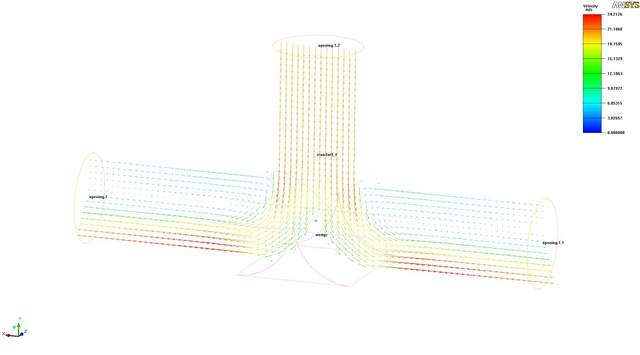
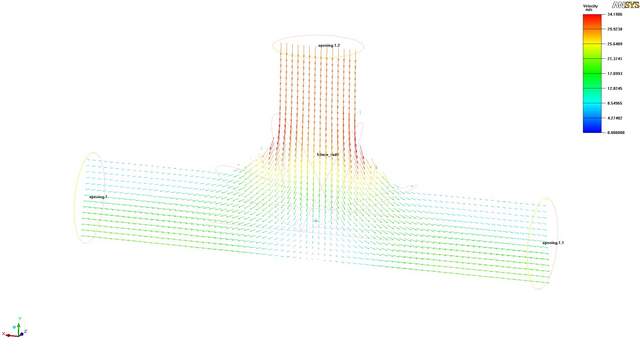
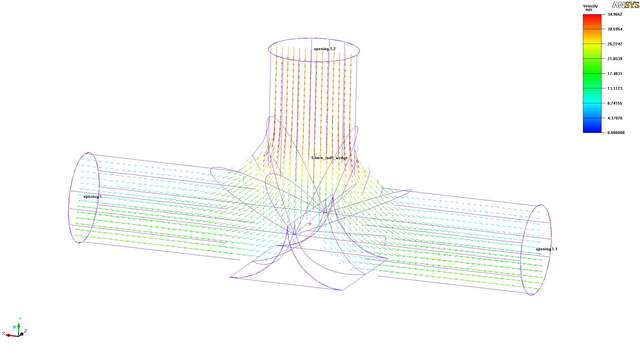
The volume flow rate results show that the T and T with wedge have almost identical flow rates. The radius-ed T with and without the wedge are both almost the same flow rates but are about 30% greater than the standard T. |
http://986forum.com/forums/general-discussions/31693-maf-throttle-body-diameter-2.html
__________________
2003 Boxster S
| 987 Air Box | K&N Air Filter | 76mm Intake Pipe| 996 76mm TB | 997 Distribution T | Secondary Cat Delete Pipes | Borla Muffler | NHP 200 Cell Exhaust Headers |
|
|
|
|
|
05-30-2015, 11:15 AM
|
#99
|
|
Ben-Auto-Design
Join Date: Oct 2014
Location: French Riviera
Posts: 827
|
I didn't read everything because I'm on my phone, but pulling air and pushing air is the same.
The engine does not pull air into it, the air is pushed inside because the atmospherique pressure is greater than the pressure inside the combustion chamber.
|
|
|
|
|
05-30-2015, 01:20 PM
|
#100
|
|
Registered User
Join Date: Aug 2009
Posts: 1,466
|
Quote:
Originally Posted by Ben006
I didn't read everything because I'm on my phone, but pulling air and pushing air is the same.
The engine does not pull air into it, the air is pushed inside because the atmospherique pressure is greater than the pressure inside the combustion chamber.
|
Exactly right, the same follow equations apply for compressed air pipe and vacuum pipe. The important thing is maintaining a constant surface cross section. The Tee even with an improved inlet radius can't do that. The turbulent area in the back of the tee is affected by flow velocity increasing in size. The higher the flow velocity the smaller the effective cross section.
__________________
2003 Black 986. modified for Advanced level HPDE and open track days.
* 3.6L LN block, 06 heads, Carrillo H rods, IDP with 987 intake, Oil mods, LN IMS. * Spec II Clutch, 3.2L S Spec P-P FW. * D2 shocks, GT3 arms & and links, Spacers front and rear * Weight reduced, No carpet, AC deleted, Remote PS pump, PS pump deleted. Recaro Pole position seats, Brey crouse ext. 5 point harness, NHP sport exhaust
|
|
|
|
 Posting Rules
|
You may not post new threads
You may not post replies
You may not post attachments
You may not edit your posts
HTML code is On
|
|
|
All times are GMT -8. The time now is 07:18 PM.
| |



 My car

 Linear Mode


